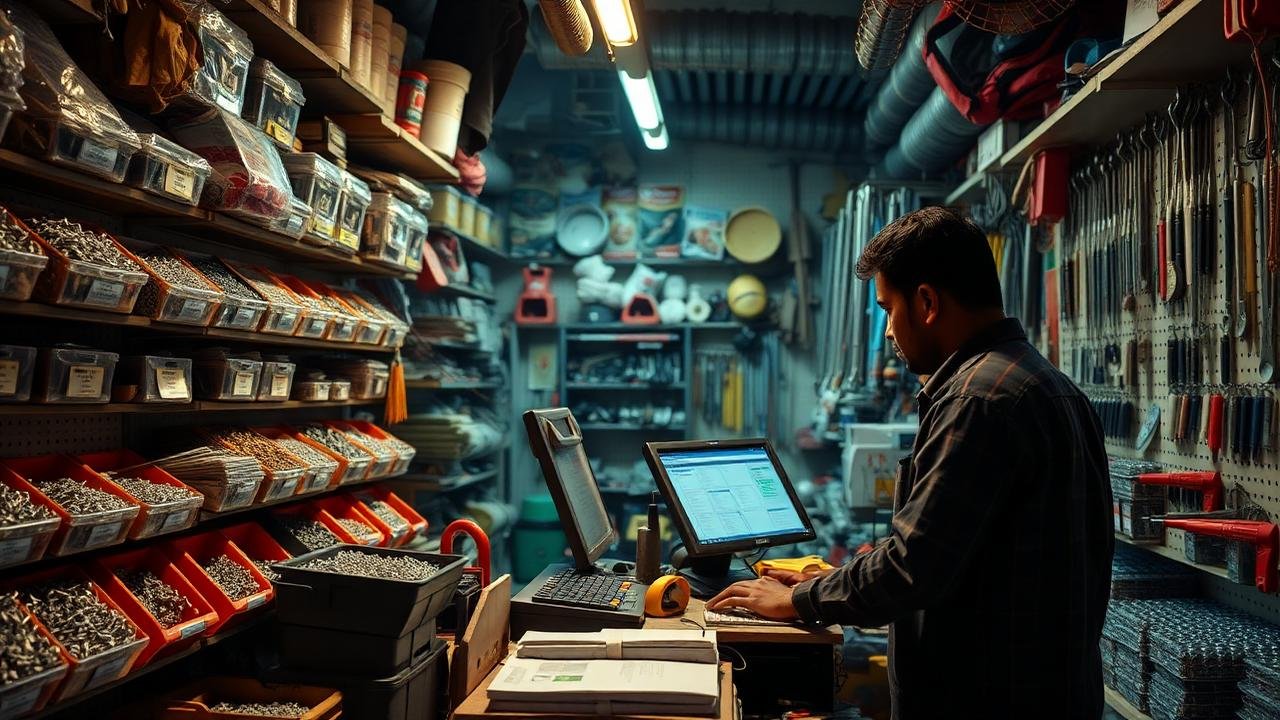
Units: the problem every hardware shop has
Busy supports a base unit and alternate units per item, with fixed or variable conversion. A bundle of twenty rods, a box of a hundred screws, a coil of ninety metres — each can be purchased in one unit and sold in another with conversion handled automatically.
Where conversion is not fixed, such as steel sold by weight but stocked by piece with varying weights, variable conversion lets the actual weight be entered at the transaction while stock stays consistent.
This one configuration removes most of the manual arithmetic at the counter, and with it most of the billing errors and stock differences hardware shops accept as unavoidable.
- Base and alternate units with fixed or variable conversion
- Weight-based billing with per-kg rate and piece stock
- Cut length and loose sale from a standard length or coil
- Bundle, box, bag and piece handling on the same item
- Rate per unit maintained separately for each selling unit
Item hierarchy: brand, size and grade
Hardware item masters get unmanageable fast because the same product exists in many sizes, grades and brands. We build a hierarchy — category, sub-category, brand, size, grade — so the master stays searchable and the reports stay meaningful.
Search at billing then works by any of these, plus alias and part number, which is how a counter person actually finds a half-inch elbow of a particular brand in three keystrokes.
Brand-wise stock and margin reporting also becomes possible, which is the basis for negotiating with your distributor at year-end.
Rates, contractors and site supply
Hardware shops rarely have one price. Walk-in, regular customer, contractor and builder rates differ, and a large site is often quoted a fixed schedule of rates for the duration of the project.
Busy holds party-wise and group-wise rate lists with date effect, so a contractor's agreed rate applies automatically and cannot be undercut by an operator at the counter.
For site supply, we set up the site as a sub-party or cost centre so materials delivered against a project accumulate into one running account, with delivery challans converted to invoices at the interval the builder prefers.
- Party, group and project-wise rate lists with date effect
- Site or project tracking as cost centre with running account
- Delivery challan to invoice conversion at any interval
- Minimum-rate validation to protect margin at the counter
Credit control where credit is the norm
Hardware trade runs on credit, and the risk sits with contractors whose own payment depends on a builder. Busy applies credit limit and credit days per party with warning or block at billing, and shows bill-by-bill ageing so a slipping account is visible early.
Interest on overdue accounts, PDC tracking and automated reminders are configured where your terms support them. For contractors, the useful view is exposure by site as well as by party.
Stock, godowns and counter discipline
Most hardware shops have a shop counter, a loft and a separate godown. Busy keeps each as a godown with transfer vouchers, so what is billed from the counter is what is at the counter, and replenishment from the godown is recorded.
Rack and bin tagging makes verification realistic. We set up section-wise counting so a shop can verify fasteners this week and sanitary next, rather than never counting at all.
Reorder levels per item and supplier-wise purchase suggestions turn ordering into a report, which matters when a shop carries several thousand small lines.
- Counter, loft and godown as separate stock locations
- Rack and bin tagging with section-wise counting sheets
- Reorder level and shortage report by supplier
- Damaged and returned goods segregated from saleable stock
GST, e-way bill and job work
Hardware sales cross several GST rates and often include freight and loading charges that must be handled correctly on the invoice. We configure bill sundries so freight, loading and packing are taxed as they should be rather than added as an afterthought.
E-way bills for site deliveries are generated from the invoice or challan with transporter details, and where you send material for cutting, threading or galvanising, job-work challans keep the stock and the GST position correct.
GSTR-1, 3B and 2B reconciliation run from the same books, which for a shop with hundreds of small purchase bills is where the input credit is protected.
Reports for a hardware owner
The reports that change decisions in a hardware shop are brand-wise margin, dead stock by category, contractor exposure by site, and daily counter sales against last month.
Busy provides all of these as standard and we pin them to your dashboard. Busy on Cloud or the mobile app puts the same figures on your phone when you are at a site rather than at the shop.
- Brand, category and item-wise gross margin
- Dead and slow-moving stock with locked value
- Party and site-wise outstanding with ageing
- Daily and monthly counter sales comparison
How we implement in a hardware shop
We clean and import the item master with units, conversions, brands, sizes, HSN codes and reorder levels, which in a hardware shop is most of the effort and most of the value.
Opening stock is taken section by section, rate lists and credit rules are configured, invoice and challan formats are designed, and counter staff are trained on the fifteen actions they will use every day. Support afterwards is by phone, remote session and on-site around Pune.
Common hardware billing cases and Busy handling| Case | Busy handling | Result |
|---|
| Buy in bundles, sell in pieces | Alternate unit with fixed conversion | Correct stock and rate automatically |
| Steel by weight, stock by piece | Variable conversion at entry | Accurate weight billing, clean stock |
| Pipe cut to length | Cut length from standard length | Balance length remains in stock |
| Contractor rate agreed for a project | Party or project rate list with date effect | Rate cannot be undercut at counter |
| Material supplied to a site over weeks | Site as cost centre with challans | One running account, invoiced on schedule |