Counter speed is a configuration decision
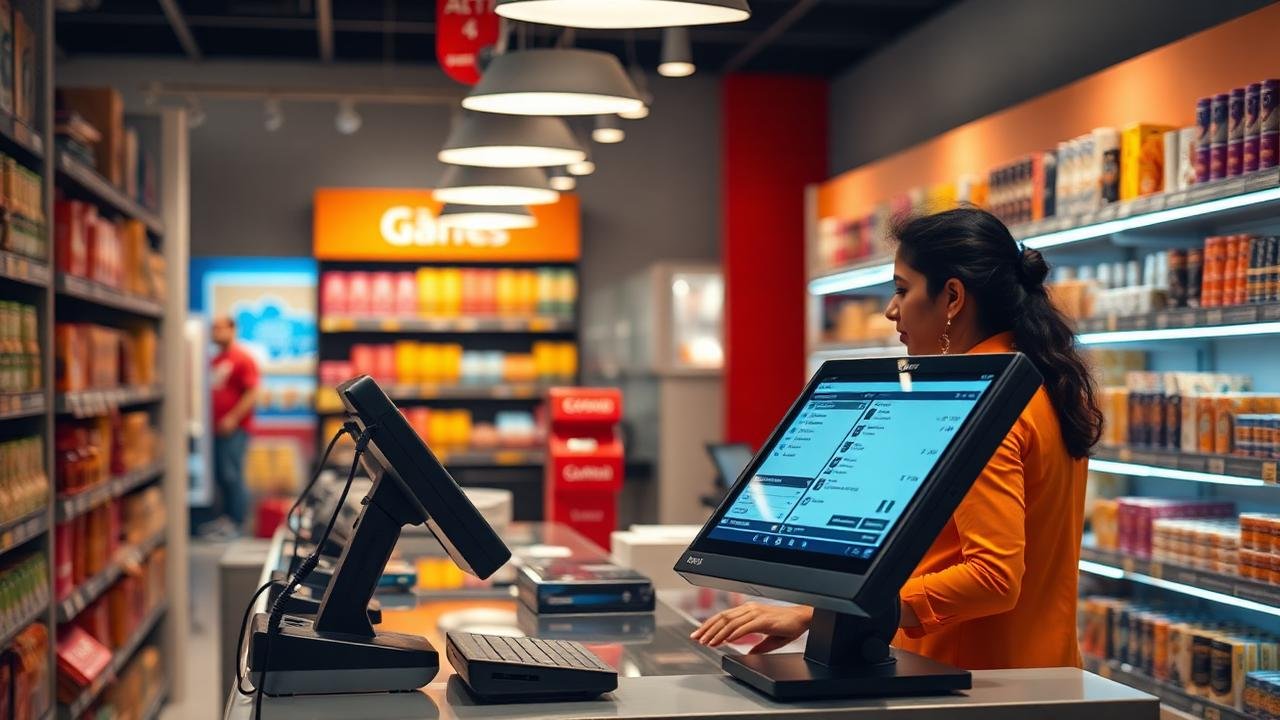
A well set-up Busy counter bills a ten-line basket in under a minute with one operator. Getting there is about the small things: barcode or short-code entry, default quantity, keyboard shortcuts for the ten most common actions, and a print format sized to your printer so nothing is adjusted per bill.
We set up the POS screen so the operator never leaves the keyboard or the touch screen: item scan, quantity, discount if authorised, payment split across cash, card, UPI and credit, print, next customer.
Where you sell loose goods, weighing-scale barcodes are decoded automatically so weight and price come straight off the label.
- Barcode, short code and touch-screen item entry
- Multiple payment modes on one bill including split settlement
- Weighing-scale barcode decoding for loose items
- Bill hold, recall and quick return at the counter
- Thermal and A4 print formats designed for your printer
Barcodes, MRP and price control
Retail stock moves through price revisions constantly. Busy handles multiple MRPs for the same item, so old stock at the previous printed price sells correctly alongside new stock, and margin is computed against the right purchase cost.
Where you print your own labels, we set up label formats with item name, MRP, barcode and batch, and a bulk printing routine for goods-receipt day.
Rate revision and MRP change reports show exactly what changed, when and by whom, which is the control most owners want once more than one person can edit rates.
Offers, loyalty and festival schemes
Retail runs on offers, and manual offers cause disputes and margin loss. In Busy, buy-one-get-one, percentage and value discounts, combo offers, bill-value slabs and happy-hour or festival-period offers are defined with validity and applied automatically.
Customer loyalty is supported through membership, point accrual and redemption, and gift vouchers, with a customer database that lets you see repeat purchase behaviour rather than treating every sale as anonymous.
Every offer's cost is reported, so at the end of a festival week you know what the promotion actually bought in additional volume and what it cost in margin.
- Automatic BOGO, slab, combo and period-based offers
- Loyalty points, membership cards and gift vouchers
- Customer database with purchase history
- Offer cost and effectiveness reporting
Stock on the shelf and in the back room
Shrinkage in retail is discovered, not prevented, unless counting is routine. We configure category and rack-wise counting sheets so staff can verify a section during quiet hours and post variance without closing the shop.
Reorder levels by category, supplier-wise purchase suggestions and fast-and-slow-moving analysis make replenishment a report rather than a walk around the shelves.
For chains, stock is held per store with transfers between them, and the head office sees consolidated as well as store-wise positions.
Day-end: cash, card and the till
The day-end routine is where retail accounting either stays clean or drifts. Busy produces a day-end summary of sales by payment mode, expected cash in the drawer, card and UPI settlement expected from the bank, and counter-wise collection.
Differences are recorded as short or excess with a reason at the time, rather than adjusted quietly a week later. Owners get the day's sales, margin and cash position on the phone through Busy on Cloud or the mobile app.
- Payment-mode wise day-end summary and cash denomination entry
- Counter and cashier-wise collection with short/excess reason
- Card and UPI settlement reconciliation against the bank
- Daily sales, margin and footfall comparison against previous periods
GST for retail, including B2C rules
Retail GST is mostly B2C, which has its own rules for consolidated reporting and its own thresholds for e-invoicing where you also sell B2B. Busy applies tax by HSN, handles inclusive-of-tax MRP billing, and produces GSTR-1 with the correct B2C summary.
Where a customer asks for a GST invoice, the same bill is converted with GSTIN capture and validation, and e-invoicing applies automatically if you are in scope.
Purchase-side reconciliation with 2B matters in retail too, because supplier bills are numerous and small; missing credit here adds up quietly across a year.
Running more than one store
For a chain, Busy Enterprise with cloud hosting or data synchronisation gives each store its own billing while the head office sees consolidated sales, stock and margin. Price and offer masters are controlled centrally so a promotion is defined once.
Inter-store transfers, store-wise profitability and store-wise stock ageing let you compare like with like, which is the basis for deciding which store gets the new range.
Implementation in a working shop
Retail implementations have to happen without shutting the counter. We import the item master with barcodes, MRPs, HSN and categories, take opening stock over a night or a Sunday, set up counters and printers, and run the first billing day alongside your staff.
Training is short and hands-on for cashiers, deeper for the store manager and accountant. After go-live we stay reachable through the first festival or sale period, which is when a retail setup is really tested.
Retail formats and the Busy setup that suits them| Store type | Edition | Typical configuration |
|---|
| Grocery / supermarket | Standard | Weighing-scale barcodes, batch, loyalty, multiple MRP |
| Apparel / footwear | Standard / Enterprise | Size-colour matrix, season tagging, style-wise margin |
| Electronics / mobile | Standard / Enterprise | Serial number and IMEI tracking, warranty, EMI modes |
| Chain of stores | Enterprise + Cloud | Central masters, store-wise P&L, inter-store transfer |